
ScaffPilot / Scaffold FEM calculation
ScaffPilot EngineerScaffold FEM calculation in seconds, not weeks.
Structural analysis built into your scaffold design software: every standard, ledger, diagonal and anchor checked against EN 12811-1 and EN 16508 load cases – straight from the 3D model.
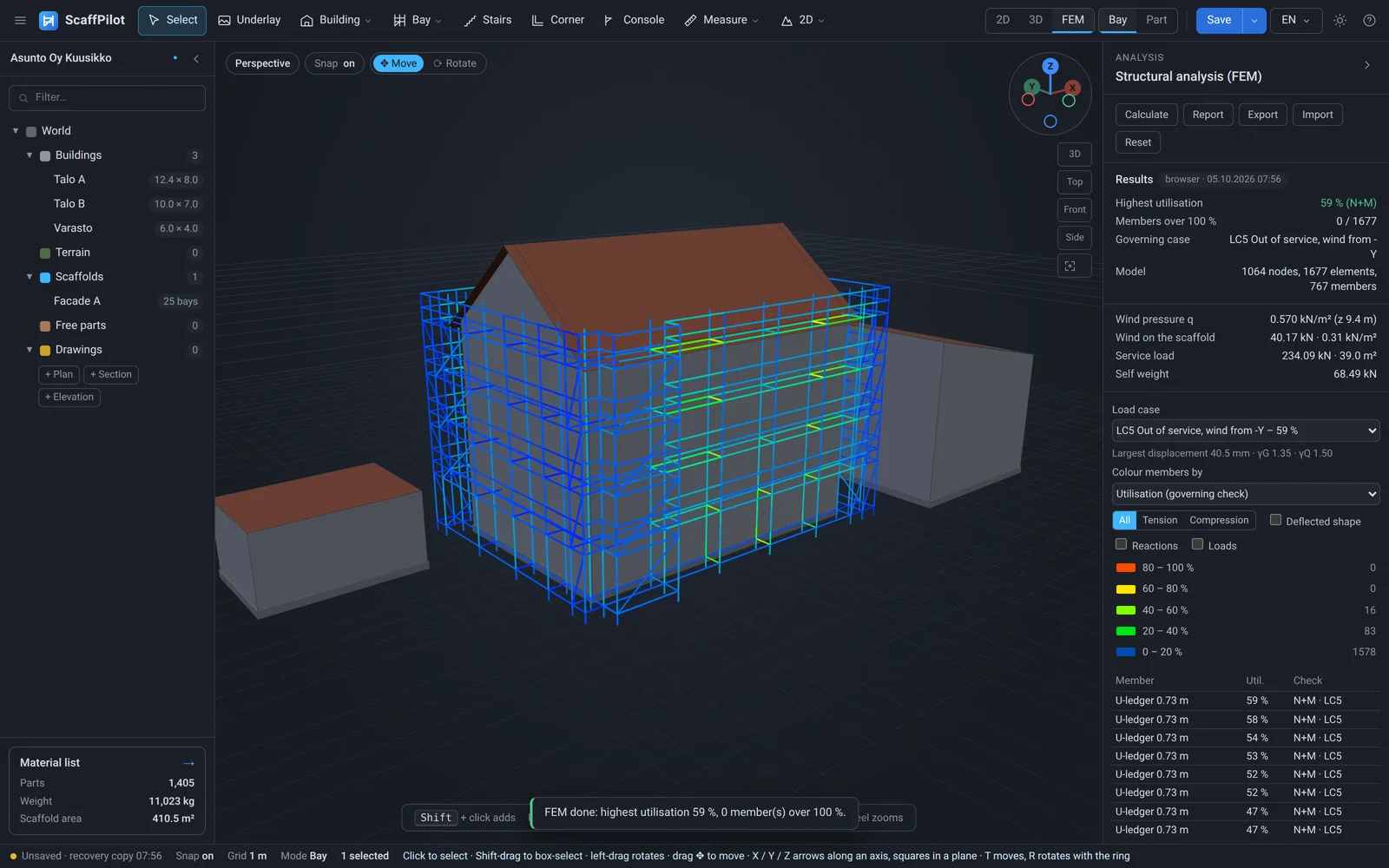
In short: ScaffPilot builds a finite-element model of your scaffold – and of its weather-protection roof – automatically, applies EN 12811-1 service loads, EN 1991-1-4 wind and snow with EN 16508 combinations, solves it with second-order (P-Δ) analysis and checks every member for section, buckling and combined N+M utilisation. You get anchor forces, base reactions, a colour-coded 3D result and a PDF report.
Why scaffolders calculate with FEM
Standard configurations from a manufacturer's instructions only cover the cases they were written for. As soon as a scaffold has cladding or netting, a loading bay, consoles, a cantilever, a weather-protection roof, irregular anchoring or extra height, the regulations expect a structural calculation. Traditionally that means sending drawings to a consultant and waiting. With ScaffPilot Engineer the calculation is part of the design itself: change the anchors, press Calculate, see the result.
What the calculation covers
Loads
- Service loads – EN 12811-1 load classes 1 to 6 per scaffold or per bay (for example class 6 on a loading bay), on the decks they actually reach.
- Wind – EN 1991-1-4 peak velocity pressure from the reference wind speed and terrain category 0–IV, on bare tubes, cladding sheets, nets, I-sections and weather-protection roofs, in service and out of service, from every direction.
- Snow – snow load classes on decks and roofs.
- Self weight – from the catalogue weight of every single part.
Analysis
- 3D frame model with semi-rigid joints, rigid links and tension-only members.
- Second-order analysis (P-Δ) by Newton–Raphson iteration, with sway imperfections.
- EN 16508 load combinations with partial factors (γG 1.35, γQ 1.50 by default) and γM for the resistance.
- Buckling lengths per member and combined axial force and bending checks (N+M) to EN 1993-1-1 (steel) and EN 1999-1-1 (aluminium).
Results
- Utilisation of every member, coloured in 3D – click a legend band to find the critical members.
- Anchor forces and base reactions per load case for the anchoring and foundation design.
- Deflected shape, displacements, axial forces and bending moments.
- FEM PDF report with the governing case, settings and member table – ready for the responsible engineer.
Weather-protection roofs in the same calculation
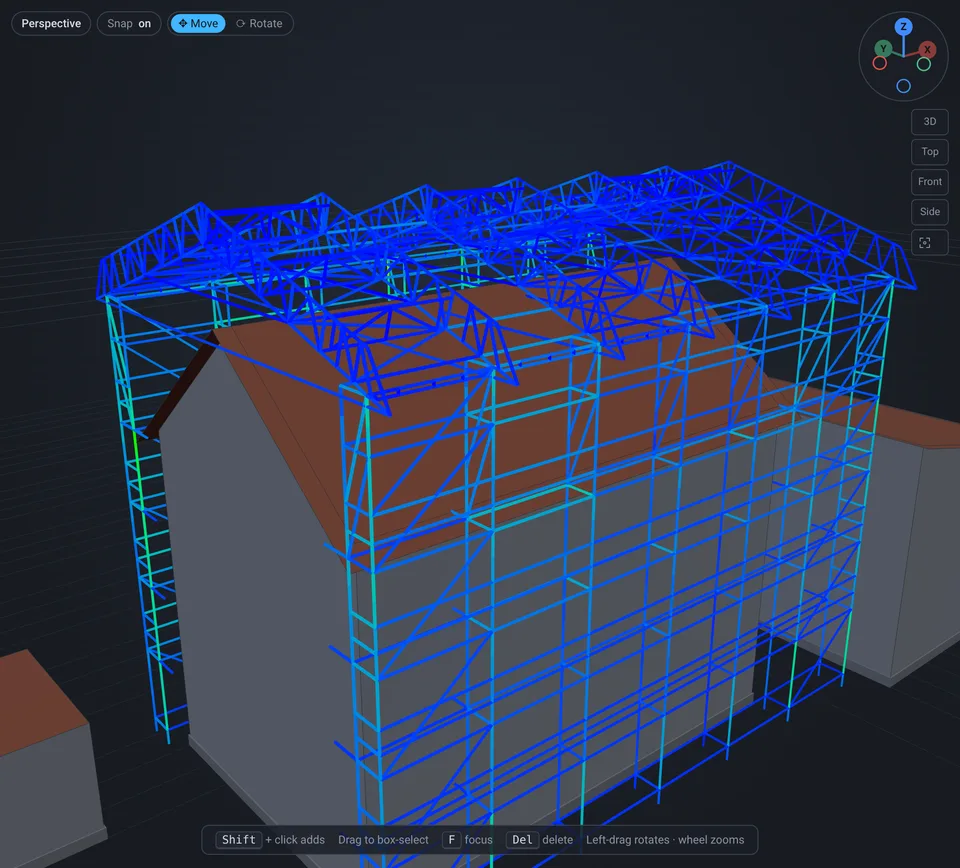
A weather-protection roof is not calculated on its own. ScaffPilot models the trusses, ridge beams, bracing and support tubes member by member and joins each truss to the scaffold where it actually bears – on a standard, or on the ledger beside it.
- Snow on the roof sheets by snow load class, and wind on the roof in and out of service, including uplift.
- The loads travel through the scaffold to the anchors and base jacks – the anchor forces and base reactions include the roof.
- Warnings for supports between standards, a roof moved along its scaffold and a roof with no support found, in the panel and in the report.
Works on the scaffolds that need it most
Facade scaffolds with consoles and cladding, stair towers, loading bays, cantilevers, round scaffolds around tanks, weather-protection roofs on scaffold and steel I-beam bridging are all part of the same model. Scaffolds imported from IFC building models are calculated the same way.
Fast because it runs on your machine
The ScaffPilot FEM solver runs in parallel web workers in your browser or desktop app – there is no queue, no upload and no per-calculation fee. It is a mechanical port of a production scaffold solver and is regression-tested against independent reference results.
See how the scaffold moves under load.
Too much movement means missing anchors or diagonals. Turn on the deflected shape, reactions and load arrows to see why – then fix it in the same model.
Start free, upgrade to Engineer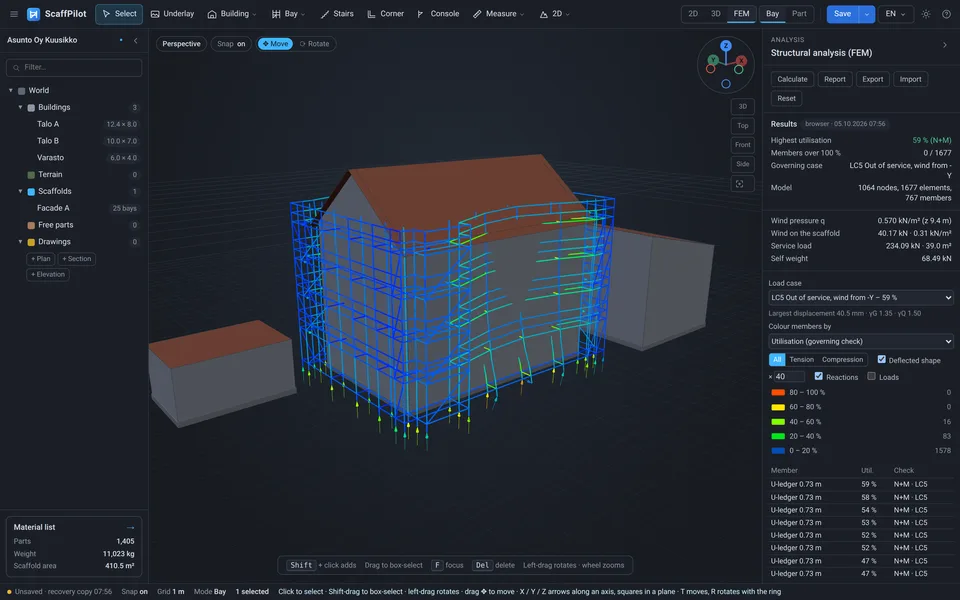
Scaffold calculation questions
What is scaffold FEM calculation?
Finite-element (FEM) calculation models the scaffold as a 3D frame of beam elements – standards, ledgers, diagonals, decks and anchors – applies the loads of every load case and solves for displacements, member forces, anchor forces and base reactions. Each member is then checked against its resistance.
Which standards does ScaffPilot use?
Service loads follow EN 12811-1 load classes 1–6, load combinations and partial factors follow EN 16508, wind follows EN 1991-1-4 with terrain categories 0–IV, and member checks follow EN 1993-1-1 for steel and EN 1999-1-1 for aluminium parts.
How long does a calculation take?
Seconds for a typical facade scaffold. The example on this page – a building wrapped in scaffold with a stair tower, 1,677 elements and every load case – solves in the browser while you watch.
Can I verify the results independently?
Yes. The FEM report documents the loads, the combinations, the governing case and the utilisation of every member, and the ScaffPilot FEM solver is regression-tested against independent reference results, which it reproduces exactly on the test models.
Is the calculation an approved structural design?
ScaffPilot does the modelling and calculation work and produces a documented report. Where national rules require a qualified engineer to approve the scaffold design, the engineer reviews and signs the ScaffPilot report – in minutes instead of days.
Which edition includes FEM?
ScaffPilot Engineer and Enterprise. Create a free account, then press Upgrade plan in the app – the request goes straight to our team, who switch your licence to Engineer.
Your next scaffold, designed and verified before lunch.
Create your account in 30 seconds and start designing in the browser. Need FEM? Upgrade with one click when you are ready.